UPDATE SEPTEMBER 8, 2026 — THE ETHICS OF LOOKING AWAY
Sopra Steria has lost control of its own root certificates, and apparently, they couldn't care less. Ordina (now acquired by Sopra Steria), the primary IT supplier for our government and justice department, categorically refuses to intervene while their cryptographic infrastructure is used for prolonged, targeted cyber espionage.
When you confront a billion-dollar company with conclusive forensic evidence of an active APT (Advanced Persistent Threat) infiltration and cryptographic hostage-taking via their certificates, you expect action. What you actually get is a wall of bureaucracy and hollow PR talk.
After the Ethics Committee formally confirmed on May 18, 2026, that they would investigate the report, on September 8, 2026, we casually received the following automated response in which the case was definitively buried:
Dear sender,
We have assessed the information provided as thoroughly as possible, based on the elements available to us. Following this review, we have been unable to confirm any of the information set out below.
This message serves as notification that the case is now closed.
Best regards,
Ethics @ Sopra Steria
This response is not a substantive refutation of the forensic APT report or the demonstrated manipulation of the macOS trust settings. It is a formal refusal to initiate an investigation — and a textbook example of active obstruction.
Throughout the entire process, Sopra Steria did not even bother to request the 100 GB of raw network logs and forensic telemetry that was offered. Those who refuse to even receive the evidence cannot technically investigate anything. Their claim that they assessed the case "as thoroughly as possible" is therefore a demonstrable sham.
When the IT supplier that manages the backbone of our networks and judicial infrastructure deliberately turns a blind eye to its own hijacked certificates, public disclosure is the only remaining option.
Deconstruction of an Ecosystem Infiltration I
By laying a chronological Time Machine backup snapshot alongside the raw telemetry from security-sysdiagnose.txt, we can expose the second structural layer of this APT campaign: a cryptographic infiltration of a workstation (MacBook Pro 16,1).
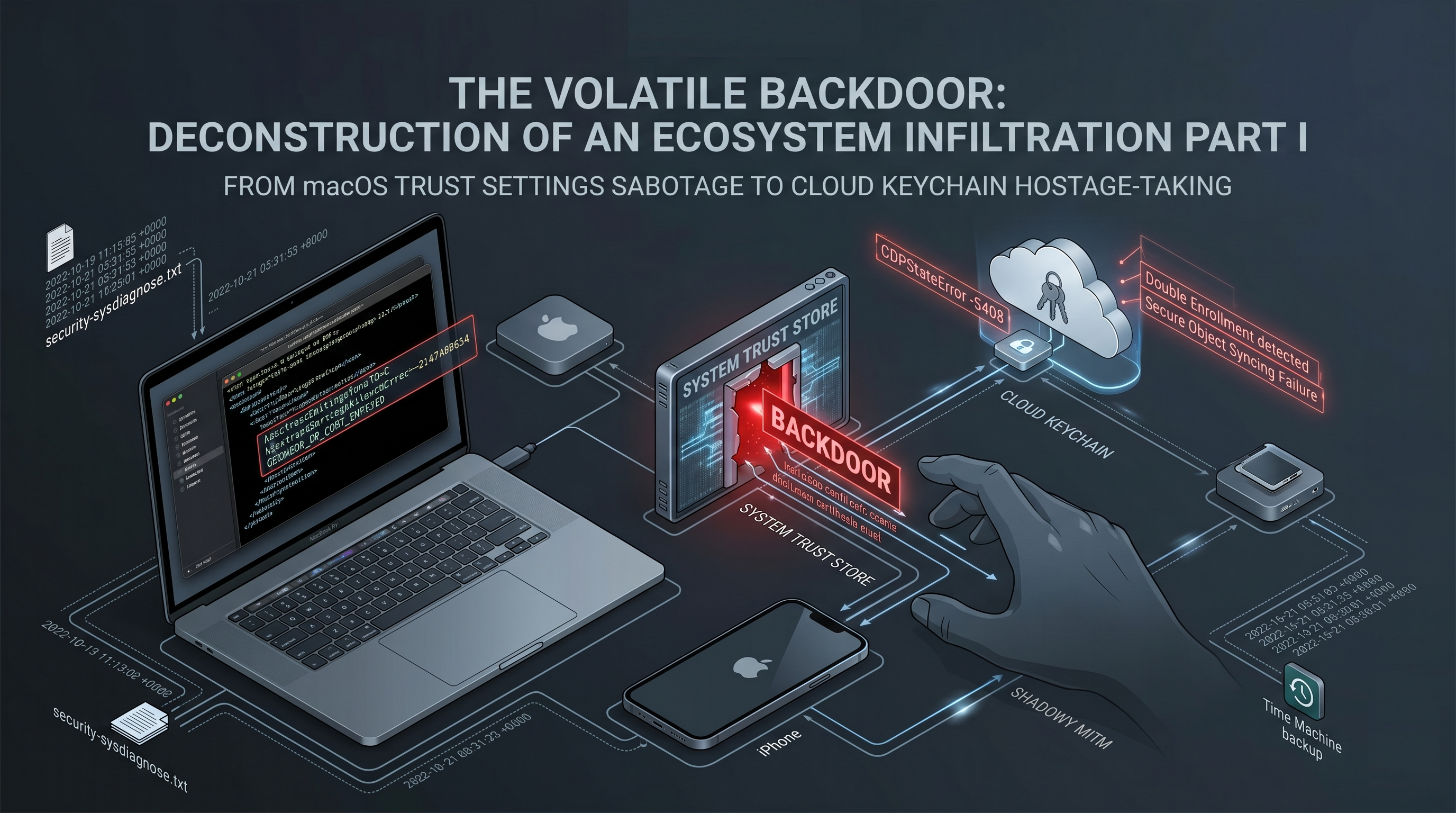
In our previous analysis, we showed how an Advanced Persistent Threat (APT) actor manipulated local radio frequencies (RRC Downgrade attacks) to isolate an iPhone on the unsecured 2G network. Forensic analysis, however, teaches us that this advanced operation did not stop at a single mobile endpoint. As soon as a target comes into sight, the entire digital perimeter is attacked.
This file shows the undeniable "Smoking Gun" of a long-term interception campaign. It proves how attackers can inject local anchors into a computer's trust engine to break open secured HTTPS connections, bypass standard OS validations, and disrupt iCloud security.
The Forensic Discovery
During a retrospective analysis of a Time Machine snapshot (dated October 24, 2022), a highly anomalous configuration file was found, deeply nested in the secure system files of the macOS operating system:
XML
<?xml version="1.0" encoding="UTF-8"?>
<!DOCTYPE plist PUBLIC "-//Apple//DTD PLIST 1.0//EN" "http://www.apple.com/DTDs/PropertyList-1.0.dtd">
<plist version="1.0">
<dict>
    <key>trustList</key>
    <dict>
        <key>1C17A02F7DF2C2AD5122FC54A46327791CD6B7E6</key>
        <dict>
            <key>issuerName</key>
            <data>OrdinaIssuingCA (DC=belgium, DC=ordina)</data>
            <key>trustSettings</key>
            <array>
                <dict>
                    <key>kSecTrustSettingsResult</key>
                    <integer>2</integer>
                    <key>kSecTrustSettingsAllowedError</key>
                    <integer>-2147409654</integer>
                    <key>kSecTrustSettingsPolicy</key>
                    <integer>1</integer> </dict>
                <dict>
                    <key>kSecTrustSettingsResult</key>
                    <integer>2</integer>
                    <key>kSecTrustSettingsAllowedError</key>
                    <integer>-2147409654</integer>
                    <key>kSecTrustSettingsPolicy</key>
                    <integer>2</integer> </dict>
            </array>
        </dict>
    </dict>
</dict>
</plist>
UPDATE (September 8, 2026): Initially, the name of the specific certificate issuer in this article was anonymized due to ongoing procedures. Given Sopra Steria's categorical refusal to investigate this cryptographic breach and the arbitrary closure of the whistleblowing report, internal channels have been formally exhausted. In accordance with the EU Whistleblower Directive, this establishes the right and necessity for public disclosure: the anonymized authority is Ordina (DC=belgium, DC=ordina, CN=OrdinaIssuingCA).
A discovery at this specific path immediately puts a forensic investigation on high alert: in this folder /Library/Security/Trust Settings/ macOS stores manual adjustments to digital trust.
When we dissect the raw structure of this XML file, it becomes visible how the system's cryptographic rules were rewritten from the outside and modified on March 10, 2022:
Plaintext

Path: /Library/Security/Trust Settings/EC179670-█████-4BDB-B6CB-4DDD6363929F.plist
Cryptographic Fingerprint: 1C17A02F7DF2C2AD5122FC54A46327791CD6B7E6
Decoded Issuer DN: DC=belgium, DC=ordina, CN=OrdinaIssuingCA
Modification-baseline: 2022-03-10 09:20:23 UTC
Phase 1: Bypassing the Cryptographic Gatekeeper
To understand the tactical intent of this configuration, we must look at how Apple handles digital certificates. Normally, macOS validates every incoming certificate against the official, strictly controlled Root Store that is baked into the OS by Apple.
By forcing this specific .plist file into the system, the attacker enforced a malicious exception:
- kSecTrustSettingsResult = 2: Within Apple's Security Framework, this value stands for
kSecTrustSettingsResultTrustAsRoot. This forces the Mac to treat this specific certificate [OrdinaIssuingCA] as a sovereign, globally trustedRoot CA. From that moment on, the computer blindly accepts anything signed by this authority. - The hijacking of the expiration date
-2147409654: This is the core of the manipulation and will further down the road reveal the broadness and infection of other devices. Within Apple's error code architecture, the number-2147409654maps exactly to the hexadecimal value0x8001210A, which stands forCSSMERR_TP_CERT_EXPIRED(Certificate expired).
By explicitly placing this error code under the key kSecTrustSettingsAllowedError, the attacker gave the OS the hard instruction: "If you encounter this certificate and the expiration date has passed, ignore the error and trust the tunnel anyway." The attacker used a proxy certificate that was deliberately backdated to October 1, 2020. Under normal circumstances, macOS would immediately disconnect due to an expired certificate. This backdoor ensured that this blockade was lifted.
Phase 2: The Correlation with the Network Logs (AnchorSource: 3)
The forensic value of this file only truly becomes clear when we make the move to the live network logs of the machine. Based on the months of October and December 2022, the computer started sounding massive alarms in its trust telemetry. Hundreds of consecutive MitmDetectionEvent logs were written with highly negative risk scores:
A 'MitmDetectionEvent' is the internal alarm notification of your operating system that demonstrates that an invisible third party (a Man-in-the-Middle) is actively trying to intercept, break open, and eavesdrop on the secure internet connection.
JSON

2022-10-19 11:13:03 +0000 EventSoftFailure: MitmDetectionEvent - Attributes: { overallScore : -11, errorDomain : MITMErrorDomain, modelid : MacBookPro16,1, build : 21G72 }
2022-10-21 05:31:53 +0000 EventSoftFailure: MitmDetectionEvent - Attributes: { overallScore : -12, errorDomain : MITMErrorDomain, modelid : MacBookPro16,1, build : 21G72 }
Forensic significance: These are the live measurements of Apple's trust engine from security-sysdiagnose.txt. The highly negative scores for the parameter MitmDetectionEvent of -11 and -12 prove with absolute mathematical certainty that the OS detected an active hijacker on the network line right before the creation of the Time Machine copy.
JSON

2022-10-21 05:58:01 +0000 EventHardFailure: TrustEvaluationEvent - Attributes: { LeafIssuanceDate : 1601510400000, AnchorSource : 3, WeakHash : 1, TrustResult : 4, MissingOCSPResponder : 1, modelid : MacBookPro16,1 }
Here we see a watertight, one-to-one relationship between the .plist file recorded by Time Machine and the system logs:
AnchorSource : 3: this parameter confirms that the trust engine traced the origin of the certificate to theUser/Admin Trust Store. This proves that the Mac was processing the exact configuration from the malicious/Library/Security/Trust Settings/folder.LeafIssuanceDate : 1601510400000: this unix timestamp translates exactly to October 1, 2020—the conclusive proof that the attacker misused the expiration date exemption in the backdoor to pilot their espionage certificate through the gate. Furthermore, upon further analysis, it was determined that this involves a multi-year compromise with an expired certificate derived from exactly that expiration date with exactly the same pattern of error messages each time.TrustResult : 4 (kSecTrustResultFatalTrustFailure): this shows the power of modern, layered OS security. Although the .plist file forced the Mac to ignore the expiration date, the attacker's interception proxy triggered other critical security rules that were not exempted: the certificate utilized an intentionally weakened algorithmWeakHash : 1.
A 360° Ecosystem Infiltration
However, the presence of this specific rogue certificate (issued on October 1, 2020) was not limited to this single workstation (MacBook Pro 16,1). Cross-device telemetry proves that we are dealing with a 360-degree APT infiltration across the target's entire Apple ecosystem.
From April 11, 2022, we see the exact cryptographic fingerprint LeafIssuanceDate : 1601510400000 and the identical pattern of TrustEvaluationEvent error messages appear in the security logs of the linked iPhone. Moreover, the metastasis does not stop there: the security-sysdiagnose.txt of a third associated device — an older MacBook Pro 11,4 — shows exactly the same traces and network errors in early 2023 (late January/early February). This confirms that the perpetrators successfully maintained the certificate cross-platform, leaving the same forensic warning flags on multiple devices within the network.
Phase 3: Escalation to Cloud Hostage-taking, the Keychain Sabotage
When an advanced attacker notices that a machine is withstanding silent network interception (the errors occurred over a very long period), the tactic shifts to active sabotage. Because the Mac's trust engine continued to block the manipulated HTTPS tunnels, the vital synchronization processes with iCloud became corrupted.
On October 23 and 24, 2022, the Client: CloudServices telemetry recorded a complete blockade within the secure synchronization network (Secure Object Syncing):
JSON

2022-10-23 16:44:59 +0000 EventHardFailure: CDPShouldRepair - Attributes: { errorDomain : CDPStateError, errorCode : -5403 }
2022-10-24 11:05:50 +0000 EventHardFailure: CloudServicesAnalyticsDoubleEnrollment - Attributes: { errorDomain : EscrowServiceErrorDomain, errorCode : 96 }
A CDPStateError means that the "trust state" (State) of a MacBook or iPhone has suddenly become corrupt. In the context of this file, errorCode: -5403 means the following:
- The device tried to repair its broken trust state with iCloud.
- It sent out the repair request.
- The proxy attacker (who was on the network as a Man-in-the-Middle) intercepted this request.
- Because the attacker does not possess Apple's unbreakable E2EE keys, the cryptographic handshake failed fatally.
- The operating system registered
error -5403, the repair failed, a secure tunnel cannot be established, the cryptographic packets do not match.
The Double Agent: "Double Enrollment" Status
Due to the aggressive interception on the iCloud endpoints, the platform entered a critical "Double Enrollment" status. This happens when an attacker captures a Mac's cryptographic login packets and tries to repeat them in a replay attack, in order to create their own 'mirror device' or nest a malicious key set within the iCloud trust chain.
Conclusion: The Dangers of Hijacked Trust
This forensic file proves that modern threats operate within a coordinated ecosystem, striking mercilessly at the intersection of active network interception and deep system configurations.
The fundamental IT security principle of Least Privilege was shockingly breached by the Issuer in this case.
However, what definitively categorizes this file as a critical security risk is that such extreme system settings were active on an external device in the first place. The coercive disabling of the time validation kSecTrustSettingsAllowedError: -2147409654 to accept an expired certificate authority constitutes a profound vulnerability.
Forensically speaking, there initially seem to be two scenarios on the table: a targeted insider threat to create a permanent backdoor, or a drastic configuration error within the corporate network management where test settings were accidentally rolled out. The scale of the infiltration, however, thoroughly undermines the theory of an 'accidental management error': simply because it is technically impossible for this configuration to have migrated 'automatically' from the Mac to the iPhone; both devices were therefore actively and deliberately infected.
A faulty corporate profile is typically limited to the specific, company-managed workstation. In this case, however, we see the malicious configuration and the associated error messages metastasize across the target's entire, personal Apple ecosystem. The presence of the espionage certificate on the work laptop (MacBook Pro 16,1), a linked private iPhone, and a second device (MacBook Pro 11,4) shows the true nature of this 360° operation. This cross-device infection proves that the trust engine was not accidentally left open locally, but that the perpetrators deliberately and systematically infected the ecosystem.
By permanently anchoring such a permissive Root CA in the Trust Settings, the perfect "Shadow Infrastructure" was created. The attackers didn't need to expend complex zero-days to blind macOS's cryptographic gatekeeper; they simply had to hitch a ride on the backdoor they actively kept open via the trust chain themselves. Once an endpoint's defense belts are neutralized, a successful interception campaign is no longer a matter of chance, but of time.
What we can do about it
To arm organizations and individuals against this hybrid form of infrastructure sabotage and configuration risks, we must revise the lines of defense:
- Zero-Trust BYOD and Guest Policy - Least Privilege: A guest network must never claim or modify the sovereign Trust Store of an external device.
- Zero Tolerance for Extreme Overrides: System-wide certificate overrides, especially ignoring the expiration status
CSSMERR_TP_CERT_EXPIRED, must not be allowed under any circumstances on consumer, guest, and peripheral devices. Such drastic configuration deviations are de facto malware facilitators. - Cross-Silo Threat Hunting: Security teams must correlate telemetry across silos. The simultaneous occurrence of
AnchorSource: 3 Hard Failures, droppingMitmDetectionEventscores, and physical overheating oftrust-daemons(such as exploding SQLite page caches in trustd) must never be dismissed as a temporary network glitch. It is the material fingerprint of an active certificate war in the background. - Ecosystem Sync Monitoring: Errors in the iCloud keychain or Core Device Protection
CDPStateErrorare not innocent software bugs. They are the proof that the operating system has rigorously closed the data ports because the underlying network environment has been cryptographically manipulated cross-device and over a long period.
Looking Ahead: The Hypothesis of Invisible Exfiltration
Now that it has been conclusively established how the door was forced and macOS's alarm systems were structurally blinded, the inevitable question arises: what was the exact target? And more importantly: was that wide-open backdoor actually used to siphon off data?
In Part II of this series, we shift the forensic investigation from the static configuration files to the blood-curdling reality of live data transmission. Using raw network packets (PCAPs), we will test a chilling hypothesis. For what if the faltering iCloud synchronization—which was central to this first part—was not an innocent side effect, but the desperate reaction of a network collapsing under massive data theft?
We are investigating the outbound data streams and hunting for the suspected correlation between the blinded trust engine and mysterious, massive uploads to hidden AWS tunnels. Was the ecosystem truly hollowed out right under our noses? The answer lies undeniably locked within the network packets...